
In recent years, mental health has quietly become one of the most pressing concerns of our time. A meta-analysis of Indian studies suggests that nearly 33% of the population has experienced psychological distress. That’s not just a number—it represents millions of individuals silently struggling.
We live in a world driven by comparison, competition, and constant validation. Social media platforms amplify curated realities, highlighting success, perfection, and “highlight reels” of life. In this environment, it’s easy to feel left behind, inadequate, or overwhelmed. Emotions like jealousy, self-doubt, and envy often go unacknowledged but deeply felt.
At the same time, our minds rarely get a moment of rest. Overthinking, self-criticism, and constant mental noise have become almost normalized. Whether it’s a child, an adult, or an elderly person, inner peace often feels distant.
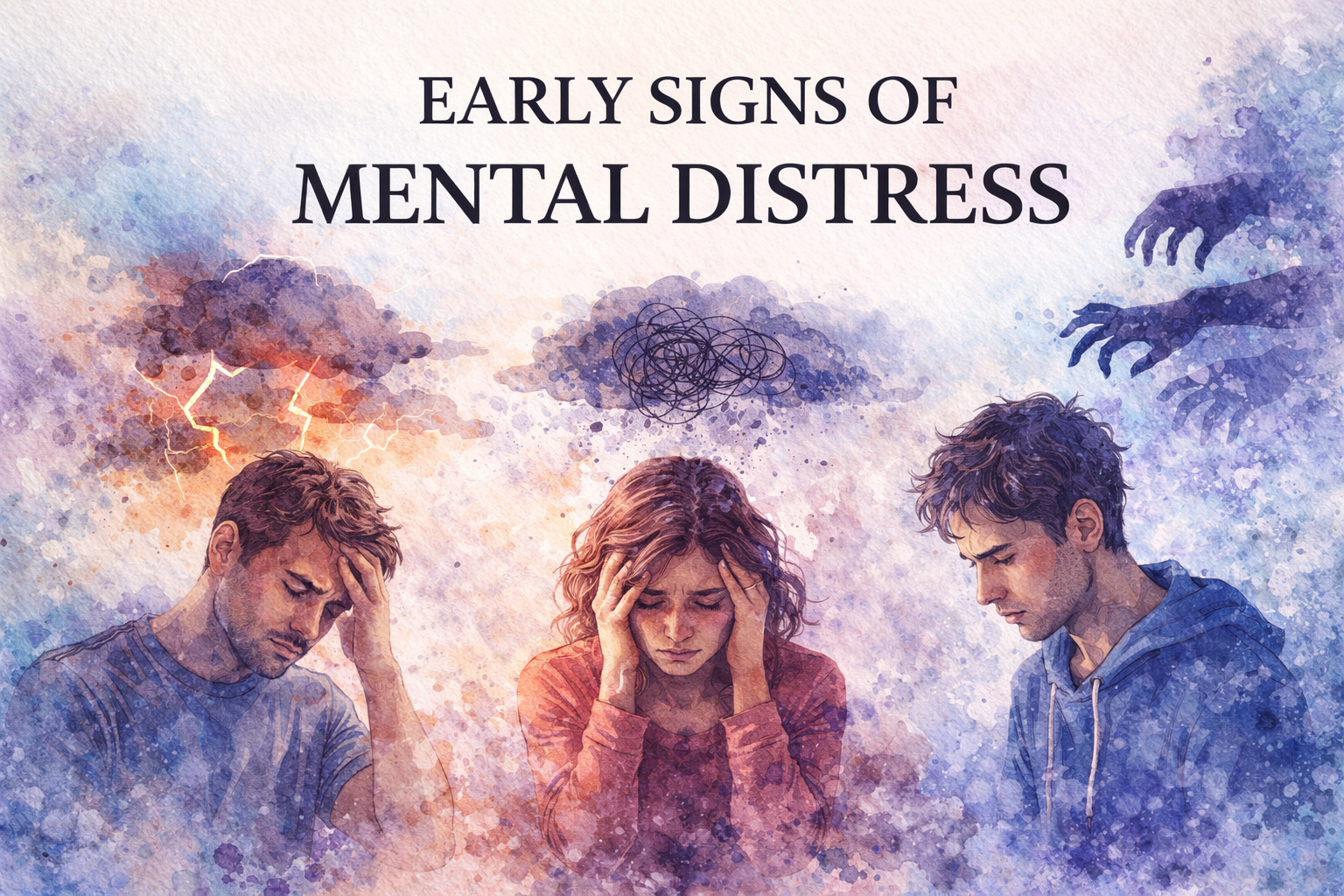
According to the American Psychological Association, mental distress is defined as a state of emotional suffering typically characterized by symptoms such as anxiety, depression, and stress. However, what often goes unnoticed is that long before any diagnosable mental disorder develops, individuals experience subtle, early warning signs.
Mental distress is not a mental disorder—it is often the initial phase, a signal that something within us needs attention.
In clinical psychology, this early stage is sometimes referred to as the Prodromal Phase—a period where symptoms begin to emerge but are not yet severe enough to meet diagnostic criteria.
The important thing to understand is this: mental distress does not begin loudly.
It starts quietly in small shifts in behavior, emotions, and daily functioning.
Some of the most common early indicators include:
● Persistent low mood or sadness
● Increased irritability or emotional reactivity
● Sleep disturbances (too much or too little)
● Reduced motivation or loss of interest
● Social withdrawal or isolation
● Difficulty concentrating
● Constant headaches or unexplained body pain
● Fatigue or low energy levels
● Emotional numbness or feeling disconnected
These signs are often dismissed as “just a phase” or “normal stress.” But when ignored, they can gradually intensify.
With the right psychological awareness, we can begin to notice these early signals—in ourselves and in others. Early recognition allows timely support, healthier coping strategies, and in many cases, prevention of more severe mental health conditions.
Mental distress is not a weakness. It is the mind’s way of asking for care, pause, and understanding.
The earlier we listen, the better we can respond.